
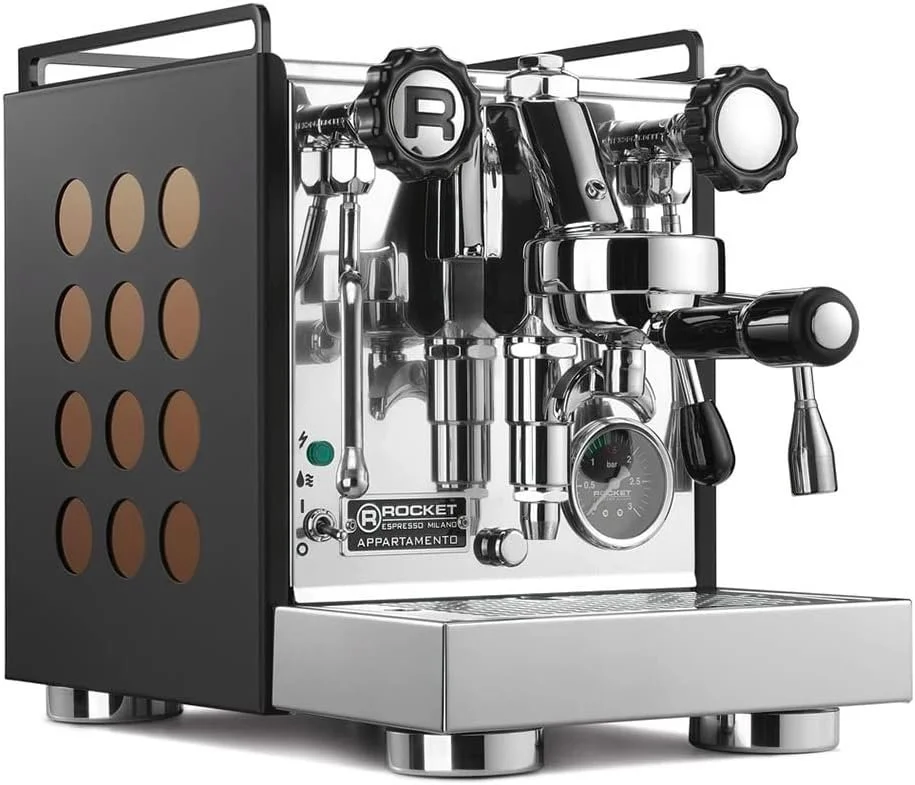
Rocket Appartamento Espresso Machine
Important note on espresso machines
Espresso machines are among the more complex appliances in terms of materials. Hot water is pushed through the system under pressure, meaning anything along that pathway could affect what ends up in your cup.
From what I’ve learned, there isn’t a perfect espresso machine. Most machines on the market still contain some level of plastic, and many use materials like PTFE (commonly known as Teflon) in tubing, gaskets, or internal components.
What matters most is reducing overall exposure by choosing machines that rely more on durable materials like stainless steel and copper, and less on plastic throughout the system.
What I try to avoid
– Excess plastic in areas where hot water flows regularly
– PTFE or “nonstick-type” materials are used in tubing or internal components when possible
– PVC tubing that may introduce phthalates
– Aluminum on food contact surfaces
– Machines with a high amount of undisclosed internal materials
What I look for instead
– Stainless steel, copper, or brass components for water pathways and boilers
– Machines with more metal tubing instead of plastic
– A design that reduces overall plastic contact with water and coffee
– Standard portafilter systems made from stainless steel
– Durable construction that supports long-term use
Product description
The Rocket Appartamento is a semi-automatic espresso machine designed with a stronger focus on materials and internal construction than many entry-level machines.
It uses a heat exchanger boiler system, which allows you to brew espresso and steam milk at the same time while maintaining a more consistent temperature. It also features an E61 group head, which supports stable brewing temperatures through continuous water circulation.
Internally, it uses a copper boiler and incorporates more metal components, which aligns with what I look for when trying to reduce plastic exposure in everyday-use appliances. Machines built this way are generally considered a step up in terms of durability and consistency.
This type of design is often found in higher-quality espresso machines and is meant to support more stable performance over time.
What stands out
– Greater use of metal components compared to many entry-level machines
– Heat exchanger system for consistent brewing and steaming
– E61 group head for temperature stability
– Copper boiler for improved heat retention
– Built for long-term use with a more durable design
Things to keep in mind
Even with higher-quality machines like this, there is no completely plastic-free option. Most espresso machines still include internal components, such as gaskets or tubing, made from synthetic materials, which is standard across the industry. This type of machine is also more hands-on and comes with a learning curve, especially with heat exchanger systems that require a brief flush before brewing. Regular cleaning and maintenance are important to keep performance consistent over time.