
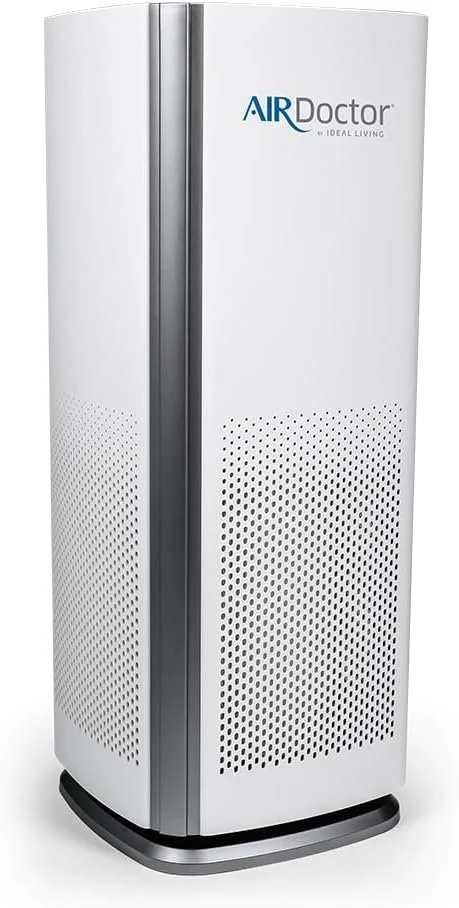
AirDoctor 1000 Air Purifier
Important note on air purifiers
Air quality is one of the biggest everyday exposures that most people don’t think about. It’s not just dust or visible particles; it’s also ultra-fine particles and gases that stay suspended in the air and are easily inhaled.
This includes VOCs from cleaning products, furniture, and fragrances, as well as mold spores, bacteria, and even viruses. Many basic air purifiers are only designed to capture larger particles, which means they’re missing a big part of what’s actually impacting your air.
If you’re investing in an air purifier, you want one that goes beyond surface-level filtration to target smaller particles and gases that are harder to remove.
What I avoid
When I’m looking at air purifiers, I try to avoid:
– Units that only target dust and larger particles
– Weak filtration systems that don’t capture ultra-fine particles
– Ozone-generating purifiers or ionizers as a primary filtration method
– Filters that don’t address VOCs or gases
– Poorly sealed units where air can bypass the filter
What I look for instead
– High-efficiency filtration capable of capturing ultra-fine particles
– Activated carbon filters to help reduce VOCs, odors, and gases
– A sealed system that forces air fully through the filter
– Consistent air circulation for ongoing filtration
Product description
The AirDoctor 1000 is designed to go beyond basic filtration by targeting both airborne particles and gases.
It uses a multi-stage filtration system that includes a pre-filter, an activated carbon filter, and an UltraHEPA filter. This type of filtration is designed to capture particles as small as 0.003 microns, which is significantly smaller than the size standard against which standard HEPA filters are tested.
Because of that, it’s able to capture a wider range of airborne contaminants, including dust, mold spores, smoke, bacteria, and viruses, not just the larger particles most purifiers focus on.
The carbon filter also plays an important role by helping reduce VOCs and gases from things like cleaning products, cooking, and off-gassing materials in the home.
It’s designed for smaller spaces like bedrooms or offices and cycles the air multiple times per hour to keep air quality more consistent throughout the day.
What I like
– Targets both ultra-fine particles and gases
– Captures much smaller particles than standard HEPA
– Includes carbon filtration for VOCs and odors
– Good option for bedrooms or smaller spaces
– Simple to use consistently
Things to keep in mind
This is designed for smaller spaces, so coverage is more limited than with larger units and may not be sufficient for open-concept areas. It uses replaceable filters, which means there is an ongoing maintenance cost, and they typically need to be changed every 6–12 months, depending on use. Some models include optional ionization features, which I personally don’t rely on and prefer to keep turned off. While it includes helpful features like auto mode, it’s still a simpler, performance-focused purifier without advanced smart integrations.